
Please read my 4 Articles on India, BJP, N Modi and the World below
- India 2026-2027: The Gathering Storm — Will Mars, Ketu and Retrograde Jupiter Trigger a National Crisis? – Astrologer Anil Aggarwala dated 5th June 2026
- From Tea Seller to Statesman: The Saturnian Rise of Narendra Modi and the Litmus Test of 2025–2029 – Astrologer Anil Aggarwala dated 23rd June 2026
- BJP Horoscope: A Fragile Pack of Cards, Not the Iron Fortress Many Astrologers Believe – Astrologer Anil Aggarwala dated 23rd June 2026
- Major Fallen Planets Jupiter, Mars and Saturn, Rising Chaos: Astrology’s Warning for the World 2027-2028 – Astrologer Anil Aggarwala dated 25th June 2026
-
The Road to 2030: Are the Present Geopolitical Crises Leading Towards a Global Confrontation?
A Prashna Marg and Kota Chakra Perspective on the Years 2027–2032
By Acharya (Dr.) Anil Aggarwala
Introduction
During the past several months, I have published a series of research articles examining India, world geopolitics and planetary transits through the principles of classical Jyotish, Prashna Marg and Kota Chakra.
Among them are:
- India 2026–2027: The Gathering Storm — Will Mars, Ketu and Retrograde Jupiter Trigger a National Crisis? (5 June 2026)
- From Tea Seller to Statesman: The Saturnian Rise of Narendra Modi and the Litmus Test of 2025–2029 (23 June 2026)
- BJP Horoscope: A Fragile Pack of Cards, Not the Iron Fortress Many Astrologers Believe (23 June 2026)
- Major Fallen Planets — Jupiter, Mars and Saturn: Rising Chaos – Astrology’s Warning for the World (2027–2028) (25 June 2026)
Taken together, these studies form a single research roadmap. My central observation is that the present geopolitical tensions may not represent isolated events but could be part of a longer astrological cycle extending into the early 2030s.
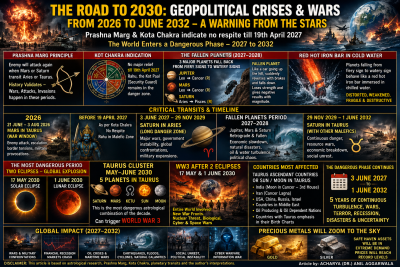
According to my interpretation of Prashna Marg, Kota Chakra and planetary transits, the years from 2027 to 2032 deserve especially close observation because of repeated concentrations of malefic influences in Aries and Taurus, culminating in an exceptional planetary configuration during May–June 2030.
Prashna Marg and the Return of Conflict
One of the classical principles described in Prashna Marg states that renewed hostilities may arise when strong malefic planets occupy Aries or Taurus.
In my earlier articles I discussed this principle in relation to contemporary geopolitical events.
For example:
- Mars entered Taurus on 21 June 2026 and remained there until 3 August 2026, a period I examined as a significant military window within this interpretive framework.
Similarly, according to my Kota Chakra analysis, the period before 19 April 2027 continues to show heightened sensitivity.
Saturn Opens a Longer Cycle
A more extended phase begins when Saturn enters Aries.
Important Period
3 June 2027 – 29 November 2029
Saturn’s transit through Aries is followed by its movement toward Taurus, where subsequent planetary concentrations become increasingly important in my research.
Because Saturn governs governments, administration, infrastructure, long-term planning and the masses, this transit may coincide—within this astrological framework—with periods of prolonged geopolitical strain rather than isolated incidents.
The Fallen Planets of 2027–2028
Another rare feature of this period is the retrograde return of three major planets from fiery signs into watery signs:
Jupiter
- Retrogrades from Leo back into Cancer.
Mars
- Retrogrades from Leo into Cancer.
Saturn
- Retrogrades from Aries back into Pisces.
In my earlier article I described these as “fallen planets,” comparing them to a vehicle that climbs a mountain only to lose control and roll backwards, or a red-hot iron bar suddenly plunged into cold water. These analogies are intended to illustrate the symbolic loss of stability attributed to such planetary reversals in traditional astrological interpretation.
The Long Shadow: 2027–2032
Viewed together, these transits suggest a prolonged period that may include:
- Heightened geopolitical rivalry
- Military build-ups
- Maritime tensions
- Energy and oil market volatility
- Economic uncertainty
- Supply-chain disruption
- Financial stress
- Greater demand for strategic commodities
From an astrological standpoint, these themes form part of one continuous cycle rather than disconnected events.
The Critical Window: May–June 2030
The central focus of my research is the planetary concentration expected around the eclipses of:
- 17 May 2030
- 1 June 2030
According to my calculations, Taurus becomes exceptionally active during this period, with a concentration of malefic and luminary influences.
Within my research model, this represents one of the most sensitive planetary configurations of the decade.
Countries whose national charts contain significant Taurus placements—including Taurus Ascendant, Taurus Sun or Taurus Moon—would, in this interpretive framework, merit particularly careful observation.
Financial Markets and Precious Metals
Historically, periods of heightened geopolitical uncertainty have often coincided with increased investor demand for traditional safe-haven assets.
From an astrological perspective, the years 2027–2032 may therefore coincide with:
- Increased market volatility
- Pressure on currencies
- Higher commodity prices
- Greater interest in precious metals such as gold and silver
Whether these trends occur will depend on a combination of geopolitical, economic and policy factors as well as the astrological cycles examined in this research.
A Unified Research Framework
The four articles published during June 2026 should be viewed as interconnected parts of a broader research programme:
- India’s internal planetary cycles
- The leadership cycle of Prime Minister Narendra Modi
- The horoscope of the BJP
- The global implications of the fallen planets
Together they form a roadmap intended to identify periods that, according to my interpretation of classical astrological principles, deserve heightened attention rather than certainty about future events.
Conclusion
The years from 2027 through 2032 may represent one of the most significant planetary transition periods of the coming decade.
According to my research based on Prashna Marg, Kota Chakra, planetary transits and eclipse cycles, the accumulation of astrological factors reaches its highest concentration around May–June 2030.
Whether history ultimately unfolds in this manner remains to be seen. The purpose of this research is not to create fear but to present a structured astrological framework for observation, discussion and future verification.
As with all predictive astrology, the passage of time provides the final test.
The whole world will be involved in wars, financial recession from the 2027 to 2032 and Prices of Precious metals will zoom to the sky.
Disclaimer
This article presents the author’s astrological research and interpretations based on classical Jyotish principles, Prashna Marg, Kota Chakra and planetary transits. It reflects an interpretive framework rather than verified forecasts of future events. Readers should treat it as astrological analysis rather than factual prediction.
Hashtags
#Astrology #VedicAstrology #PrashnaMarg #KotaChakra #WorldAstrology #Geopolitics #Saturn #Jupiter #Mars #Eclipses #India #GlobalEconomy #Gold #Silver #Research #AstroDocAnil #AcharyaAnilAggarwala
