
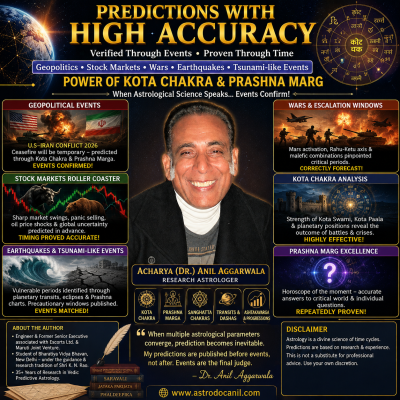
When Predictions Meet Events: Kota Chakra & Prashna Marga Put to the Test
From War Escalation and Geopolitical Upheaval to Stock-Market Roller Coasters and Natural Calamities — A Retrospective Study of My Predictions
By Acharya (Dr.) Anil Aggarwala
Research Astrologer | Vedic Predictive Astrology
Introduction — Prediction Must Come Before the Event
The real test of predictive astrology is not explaining an event after it has happened.
The real test is identifying a sensitive period before the event unfolds, publishing the astrological reasoning, specifying the planetary combinations involved and then waiting for events to provide the verification—or rejection—of the prediction.
Over the years, this has remained the foundation of my research.
My work on geopolitical conflicts, wars, stock-market volatility, earthquakes, tsunami-like events and major political upheavals has repeatedly employed classical principles of Vedic Astrology, particularly:
- Prashna Marga
- Kota Chakra
- Rashi Sanghatta Chakra
- Nakshatra Sanghatta Chakra
- Planetary ingress charts
- Eclipses
- Retrogression and combustion
- Mars–Saturn relationships
- Rahu–Ketu
- Mundane horoscopes
- Vimshottari Dasha
- Ashtakavarga
- Progression charts
- The Theory of Inevitability
My purpose has never been merely to look at an event and subsequently find an astrological explanation for it.
The objective is much more demanding:
Can astrology identify the vulnerable window before the event?
This article examines some of those predictions and the principles behind them.
About the Author — From Engineering to Predictive Astrology
I am Acharya (Dr.) Anil Aggarwala, a Research Astrologer with an engineering and senior corporate-management background.
Before dedicating myself extensively to astrological research, I held responsible professional positions associated with Escorts Ltd. and the Maruti joint-venture environment.
My engineering background naturally influenced my approach towards astrology.
I wanted parameters.
I wanted correlations.
I wanted repeatable principles.
Most importantly, I wanted to know whether a prediction could be documented before an event and subsequently compared with what actually happened.
My formal study of astrology at Bharatiya Vidya Bhavan, New Delhi, and my exposure to the research tradition of the legendary Shri K. N. Rao strengthened this approach enormously.
Over the years, I have increasingly concentrated on predictive techniques capable of identifying the timing of events, rather than relying upon generalized astrological descriptions.
Kota Chakra — The Fortress That Speaks the Language of War
Among the techniques that have fascinated me most is the Kota Chakra.
Kota literally represents a fort or fortress.
Traditionally, the Chakra has been applied to questions involving invasion, warfare, the strength of the attacker and defender, danger to a ruler and the ability of a fortress to withstand attack.
In modern mundane astrology, these principles can be extended to the study of:
wars, governments, political survival, military confrontations and prolonged geopolitical crises.
The strength of the Kota Swami, Kota Paala, the movement of planets through the different divisions of the Chakra and the entry or exit of malefic planets can provide important clues regarding the development of a conflict.
The technique becomes particularly powerful when its indications repeat what is independently visible through Prashna Marga and Sanghatta Chakras.
Prashna Marga — The Horoscope of the Question and the Event
A birth horoscope is frozen at the moment of birth.
A Prashna horoscope is different.
It is a dynamic chart erected for the moment a serious question arises or for an important event requiring investigation.
This makes Prashna particularly useful in rapidly changing situations such as:
- Will a ceasefire survive?
- Will a war escalate?
- Will negotiations succeed?
- Which side has the advantage?
- Will financial markets react violently?
- Is a particular period vulnerable to destructive events?
The beauty of Prashna is that it provides an independent chart.
When the Prashna chart, mundane horoscope, transits, Kota Chakra and Sanghatta Chakras all begin to speak the same astrological language, the probability of a significant event deserves serious attention.
The U.S.–Iran Conflict — A Major Test of Kota Chakra
The geopolitical developments of 2026 provided an extraordinary laboratory for these techniques.
I analysed the war situation through the chart connected with:
28 February 2026 — 09:45 hrs, Tehran
My Kota Chakra analysis did not indicate an easy or permanent conclusion to the confrontation.
One of the most important considerations was the position of Rahu as Kota Paala.
Rahu is associated astrologically with:
confusion, unconventional warfare, deception, sudden reversals, hidden activity and situations that refuse to proceed in a straightforward manner.
Therefore, even when diplomatic initiatives or ceasefires appeared, I remained cautious about declaring that the conflict had ended.
The Ceasefire — Why I Called It Temporary
When the possibility of peace appeared, it would have been easy to conclude that the crisis was over.
But the astrological picture was telling a different story.
The Kota Chakra, Rashi Sanghatta Chakra, Nakshatra Sanghatta Chakra and Prashna Marga continued to show unresolved adverse combinations.
Therefore, my published assessment was essentially:
The ceasefire may provide temporary relief, but it does not represent lasting peace.
The reason was simple.
The planets producing the conflict had not ceased to operate.
If the root combinations remain active, a political announcement by itself cannot be treated astrologically as the end of the underlying cycle.
Subsequent developments broadly followed the pattern of renewed confrontation rather than permanent peace.
Mars — The Trigger Planet
In mundane astrology, Mars deserves extraordinary attention.
Mars signifies:
war, weapons, armies, aggression, explosions, fire, accidents, bloodshed, confrontation and decisive military action.
But merely saying “Mars signifies war” is insufficient for prediction.
The important questions are:
Where is Mars?
Which Nakshatra is Mars occupying?
Which planets does Mars influence?
Is Saturn obstructing Mars?
Are Rahu or Ketu involved?
Is an eclipse axis activated?
What does the Kota Chakra show?
Does the Prashna chart confirm the same event?
It is the repetition of indications that converts an ordinary transit into a potentially significant predictive window.
Prashna Marga and the Aries–Taurus Warning
One principle to which I have repeatedly drawn attention is the danger associated with severe malefic activation of the Aries–Taurus sector, particularly when powerful slow-moving malefics become involved.
This becomes increasingly important as we approach the later part of this decade.
I have therefore repeatedly maintained that temporary periods of peace should not automatically be interpreted as the end of global instability.
The larger planetary cycle has to be examined.
Stock Markets — Why Geopolitics Produces the Roller Coaster
War does not remain confined to the battlefield.
Modern financial markets react almost instantaneously to:
oil prices, shipping disruptions, sanctions, tariffs, interest rates, inflation, military escalation and geopolitical uncertainty.
Therefore, the same planetary configurations that indicate geopolitical stress can indirectly produce violent movements in:
equities, commodities, crude oil, gold, currencies and bond markets.
This is why I have repeatedly described the markets as entering roller-coaster phases rather than moving continuously in one direction.
Astrologically, particular attention has to be paid to:
Jupiter
Finance, expansion, judgement, banking and optimism.
Mercury
Commerce, trading, communication and market psychology.
Mars
Sudden aggression, panic and sharp movements.
Saturn
Fear, contraction, restriction and prolonged pressure.
Rahu
Speculation, exaggeration, sudden reversals and abnormal behaviour.
When these planets become simultaneously afflicted, markets can move sharply in one direction and then reverse just as dramatically.
War → Oil → Inflation → Markets
One of the most important lessons of 2026 has been the close connection between geopolitical events and financial markets.
The chain can develop rapidly:
War Escalation
↓
Threat to Shipping and Energy Routes
↓
Rise in Crude-Oil Prices
↓
Inflationary Fear
↓
Bond-Yield Pressure
↓
Stock-Market Volatility
Thus, an astrological indication of geopolitical escalation may ultimately manifest simultaneously through several apparently unrelated channels.
The battlefield and the stock exchange can therefore become two expressions of the same larger geopolitical cycle.
Earthquakes and Tsunami-Like Events — A Different Application
Natural calamities require even greater caution because no single planetary combination should be treated as automatically producing an earthquake or tsunami.
In my research, I look for a cluster of adverse indications, particularly involving:
- eclipses,
- Mars,
- Saturn,
- Rahu–Ketu,
- afflicted watery signs,
- sensitive ingress charts,
- New Moon and Full Moon configurations,
- and repetition through mundane and Prashna parameters.
For tsunami-like phenomena, the involvement of watery signs and severe malefic influences becomes particularly important.
But an astrologer should not declare that every difficult Mars–Saturn combination will cause an earthquake.
Repetition is the key.
Several independent parameters should converge before a period is classified as exceptionally vulnerable.
Why Earthquake Prediction Is More Difficult Than War Prediction
There is an important distinction.
A war has identifiable actors.
We can erect charts for countries, governments, attacks, ceasefires and negotiations.
An earthquake does not have a political decision-maker.
Therefore, identifying an exact geographical location and magnitude astrologically is substantially more difficult.
This is precisely why date-window prediction and subsequent verification become so important in research.
The objective should be to accumulate cases rather than claim success from one isolated coincidence.
The Theory of Inevitability
One of the most powerful concepts in my predictive approach is what I describe as the Theory of Inevitability.
A major event normally does not depend upon one astrological parameter.
Suppose:
- the country’s Dasha is adverse,
- the mundane chart is activated,
- an eclipse touches the sensitive degrees,
- Mars triggers the same region,
- Saturn reinforces it,
- the Prashna chart repeats the indication,
- and Kota Chakra also shows penetration or weakness.
Then several independent astrological techniques are pointing towards the same result.
That is when prediction acquires strength.
One indication may fail.
Two may represent coincidence.
But when multiple independent parameters converge within the same narrow period, the astrologer has a much stronger basis for making a forecast.
Prediction Versus Retrospective Astrology
There is a very simple test that every serious researcher should accept.
Was the prediction available before the event?
If yes, compare:
Prediction → Date → Astrological Reasoning → Actual Event
If not, it should be described as retrospective analysis rather than prediction.
This distinction is crucial.
Astrology can advance as a serious field of research only when predictions are preserved with their original publication dates and subsequently subjected to verification.
My Research Principle
My approach can therefore be summarized in five stages:
1. Identify the sensitive planetary configuration.
2. Apply more than one predictive technique.
3. Define the vulnerable time window before the event.
4. Publish the prediction.
5. Compare the forecast with subsequent events.
Successes should be recorded.
Failures should also be recorded.
That is how a predictive technique is tested.
2026 Is Not the End of the Story
The larger concern is that the planetary picture does not suggest that the world’s geopolitical problems simply disappear after one ceasefire or one diplomatic settlement.
There may be alternating phases:
Escalation → Negotiation → Temporary Peace → Breakdown → Renewed Escalation
This is precisely why Kota Chakra must be studied dynamically.
A fortress may receive temporary relief without the war itself having permanently ended.
The Road Towards 2027–2032
My research therefore extends beyond the immediate events of 2026.
The coming movements of Saturn, Mars, Jupiter, Rahu–Ketu and the eclipse axis deserve close observation.
Of particular importance in my research is the period when malefic influences increasingly activate Aries and Taurus.
The later part of the decade, and particularly the configurations approaching 2029–2032, therefore require serious astrological study.
This should not be interpreted as a declaration that catastrophe must occur on every sensitive date.
Rather, these are periods in which the planetary environment, according to the principles I employ, warrants considerably greater vigilance.
From Prediction to Verification
What makes the recent period especially important for my research is not one isolated successful forecast.
It is the repeated appearance of the same broad themes:
Geopolitical escalation.
Fragile ceasefires.
Renewed warfare.
Oil-price shocks.
Stock-market roller-coaster movements.
Political instability.
Earthquake and tsunami-like vulnerability during selected windows.
When predictions are made and time-stamped before events, they create a body of material that can subsequently be examined objectively.
This is where Kota Chakra and Prashna Marga become research tools rather than merely theoretical concepts.
Conclusion — When the Planets and Events Speak the Same Language
The purpose of predictive astrology should never be to create fear.
Its purpose is to identify time.
When is the environment supportive?
When is it vulnerable?
When should governments exercise restraint?
When should investors become cautious?
When are military agreements fragile?
And when do several independent astrological parameters converge strongly enough that an astrologer must issue a warning?
My experience with Kota Chakra, Prashna Marga, Sanghatta Chakras, eclipses and planetary transits has convinced me that their greatest value emerges when they are used together.
One planetary combination gives an indication.
Several independent combinations repeating the same indication create a prediction worthy of serious examination.
And when that prediction has been placed in the public domain before the event, subsequent events provide the ultimate test.
That is the essence of my continuing research into Vedic Predictive Astrology.
Research Note & Disclaimer
This article presents the author’s astrological research, interpretations and retrospective comparison of previously published forecasts with subsequent events. Astrology is an interpretative discipline and is not scientifically established as a method for predicting wars, earthquakes, tsunamis, financial markets or political events.
References to apparent predictive accuracy should therefore be understood as the author’s assessment and should ideally be evaluated against the original, time-stamped forecasts and clearly defined prediction windows.
Nothing in this article constitutes financial, investment, political, military, geological, disaster-management or other professional advice. Official earthquake and tsunami warnings from scientific and governmental authorities should always take precedence.
