
Introduction
The developments unfolding in West Asia during June 2026 have once again demonstrated that wars are rarely decided by diplomacy alone. While political leaders announced a ceasefire between the United States and Iran and projected it as a major breakthrough, the underlying tensions remained unresolved.
Within days of the agreement, fresh disputes emerged regarding the Strait of Hormuz, regional military activities, and allegations of violations by both sides. The ceasefire, instead of ushering in lasting peace, has become increasingly fragile and uncertain.
What makes these events particularly noteworthy is that this outcome was repeatedly indicated in my earlier research articles published on my website, based on the ancient principles of Kota Chakra and Prashna Marga. These traditional predictive tools consistently suggested that the conflict would not end merely through declarations or temporary agreements while the primary indicators of hostility remained active.
21 June 2026, the ceasefire appears to be under severe strain and many analysts are describing it as fragile, partially violated, and at risk of collapse, although neither Washington nor Tehran has formally declared it dead. All my Predictions are turning out True as per Kot Chakra and Prashna Marg Principles
What has happened?
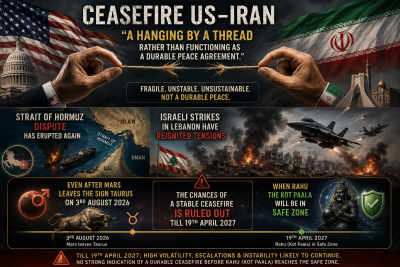
1. Strait of Hormuz dispute has erupted again
Iran announced that it was closing the Strait of Hormuz, claiming the US and Israel had violated commitments associated with the ceasefire. However, the US military immediately stated that shipping traffic was still moving and that American forces were monitoring the waterway.
This is significant because the Strait of Hormuz was one of the most sensitive issues in the negotiations. A dispute over the strait is often viewed as a signal that trust between the parties is breaking down.
2. Israeli strikes in Lebanon have reignited tensions
Several Israeli strikes in southern Lebanon reportedly killed dozens of people, prompting accusations that ceasefire understandings were being violated. Iran responded by warning that agreements could collapse if attacks continued.
3. Emergency diplomacy is underway
The fact that Vice President J. D. Vance flew to Switzerland for urgent talks with Iranian negotiators shows that both sides believe the agreement is in danger and requires immediate intervention.
Why many observers say the ceasefire is “in the ditch”
Several developments point in that direction:
| Indicator | Status |
|---|---|
| Direct US-Iran fighting stopped | Mostly Yes |
| Naval blockade lifted | No |
| Hormuz dispute resolved | No |
| Israel-Lebanon front stable | No |
| Trust between parties | Very low |
| Long-term agreement signed | No |
The naval blockade of Iranian ports reportedly remains in effect, which means one of the key wartime pressures has not been removed.
Current Assessment
The situation today can be summarized as:
Military ceasefire: Alive but wounded.
Political agreement: Not secured.
Regional stability: Deteriorating.
Risk of renewed hostilities: High.
Relation to your earlier astrological thesis
Without commenting on the validity of any predictive method, it is a factual observation that:
- The ceasefire has not produced a stable settlement.
- Maritime tensions have returned.
- Lebanon remains active.
- Negotiations are continuing because the existing arrangement is proving insufficient.
- Both sides are still preparing for contingencies rather than behaving as if a final peace has been achieved.
So from a geopolitical perspective, it would be reasonable to describe the current ceasefire as “hanging by a thread rather than functioning as a durable peace agreement.”
Why the Ceasefire Was Unlikely to Succeed
According to the principles of Kota Chakra, the security structure of the conflict remained under the influence of hostile forces. The Kotapal (guardian of the fortification) continued to occupy a war-oriented zone, indicating that the conditions necessary for permanent peace had not yet emerged.
Similarly, Prashna Marga clearly states that when powerful malefic influences continue to dominate the signs governing conflict and enemy activity, agreements reached during such periods often prove temporary and unstable.
The astrological indicators showed that:
- Mars remained active in the Aries–Taurus zone, sustaining military aggression.
- Rahu–Ketu continued to influence the conflict axis.
- The fundamental causes of confrontation remained unresolved.
- Diplomatic efforts could provide only temporary relief rather than a final settlement.
Prediction Vindicated
For several months, my articles emphasized that any ceasefire announced during this period would remain vulnerable to breakdowns, renewed accusations, military posturing, and fresh flashpoints.
The recent deterioration in the ceasefire environment appears to support that assessment. Although direct hostilities may temporarily reduce, the larger geopolitical confrontation remains unresolved.
Looking Ahead
The Kota Chakra continues to suggest caution. Until the principal malefic influences vacate the critical conflict zones and the Kotapal moves away from the war sector, the possibility of renewed tensions cannot be ignored.
The events of June 2026 serve as another example of how ancient predictive systems such as Kota Chakra and Prashna Marga can provide valuable insight into geopolitical developments, often revealing underlying trends that remain hidden beneath diplomatic announcements and media narratives.
Time will ultimately determine the final outcome, but the present developments indicate that the road to lasting peace remains uncertain and challenging.
Even after Mars leaves the sign Taurus on the 3rd August 2026the chances of a stable ceasefire is ruled out till 19th April 2027 when Rahu the Kot Paala will be in safe zone
Short Disclaimer
This article presents an astrological research perspective based on the principles of Kota Chakra and Prashna Marga. The analysis represents the author’s interpretation of traditional Jyotish methods and is intended solely for research, educational, and discussion purposes. It should not be construed as political, military, financial, or strategic advice.
