
About the Author
Acharya Anil Aggarwala is an engineer-turned-astrologer and research disciple of Shri K. N. Rao from Bharatiya Vidya Bhavan, New Delhi. A recipient of the Saroj Memorial Award for Astrology Research, he specializes in Mundane and Financial Astrology, applying classical techniques to study global events, market cycles, and precious metals through astrological timing.
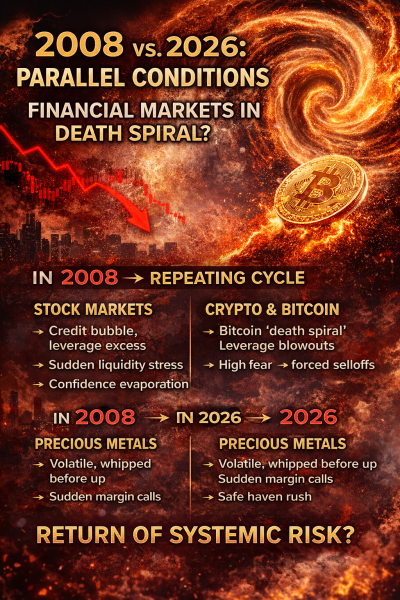
2008 vs 2026: The 18-Year Cycle — Are Markets Entering a Parallel Breakdown?
The global financial crisis of 2008 did not erupt overnight. It unfolded through excess leverage, speculative bubbles, liquidity stress, and sudden loss of confidence. Eighteen years later, 2026 presents an eerily similar backdrop across multiple asset classes.
Why the 18-Year Cycle Matters
Historically, markets tend to revisit stress patterns in long cycles specially connected to the Nodes tied to:
-
Credit expansion → leverage saturation
-
Asset bubbles → forced deleveraging
-
Confidence shocks → rapid price air-pockets
In astrology-based market timing, such cycles often re-activate under comparable planetary stress signatures, creating parallel outcomes, not identical events.
Stocks: Fragility Beneath the Surface
-
Narrow leadership and stretched valuations
-
Liquidity sensitive to policy signals
-
Sharp reactions to geopolitical and policy headlines
These conditions mirror the late-2007 to early-2008 phase when cracks appeared before the collapse.
Crypto & Bitcoin: The “Death Spiral” Risk
Bitcoin’s structure is highly sensitive to:
-
Liquidity withdrawal
-
Forced liquidations
-
Loss of narrative confidence
When risk assets de-risk together, crypto often amplifies the move. A synchronized downturn with equities can create a self-reinforcing liquidation loop—what many now call a “death spiral.”
Precious Metals: Volatility Before Direction
As in 2008, gold and silver can experience violent sell-offs first (margin calls), followed by strong recoveries as capital seeks safety. This whipsaw behavior is typical during systemic stress windows.
The Key Parallel
2008 taught us that markets don’t crash because of one trigger—they crash when multiple weak links align.
In 2026, the alignment appears across:
-
Equities
-
Crypto
-
Credit sensitivity
-
Geopolitical uncertainty
This does not mean history repeats exactly—but it often rhymes with force.
Strict Disclaimer
This article is a comparative market study using historical, cyclical, and astrological timing frameworks and is intended strictly for educational and research purposes. It does not constitute investment advice, trading recommendations, or price predictions. Financial markets involve substantial risk, and readers must rely on official information and qualified financial professionals before making any decisions.
#MarketCycles
#2008Crash
#2026Markets
#SystemicRisk
#BitcoinVolatility
#StockMarketStress
#FinancialAstrology
#MarketTiming
#EducationalPurposeOnly
